
Pablo Fuchsberger

Farmflation™

How to farm assets and
protect ourselves from inflation

«Your wealth is already planted in inflationary soil. You can't choose the soil. You can choose what you plant.»

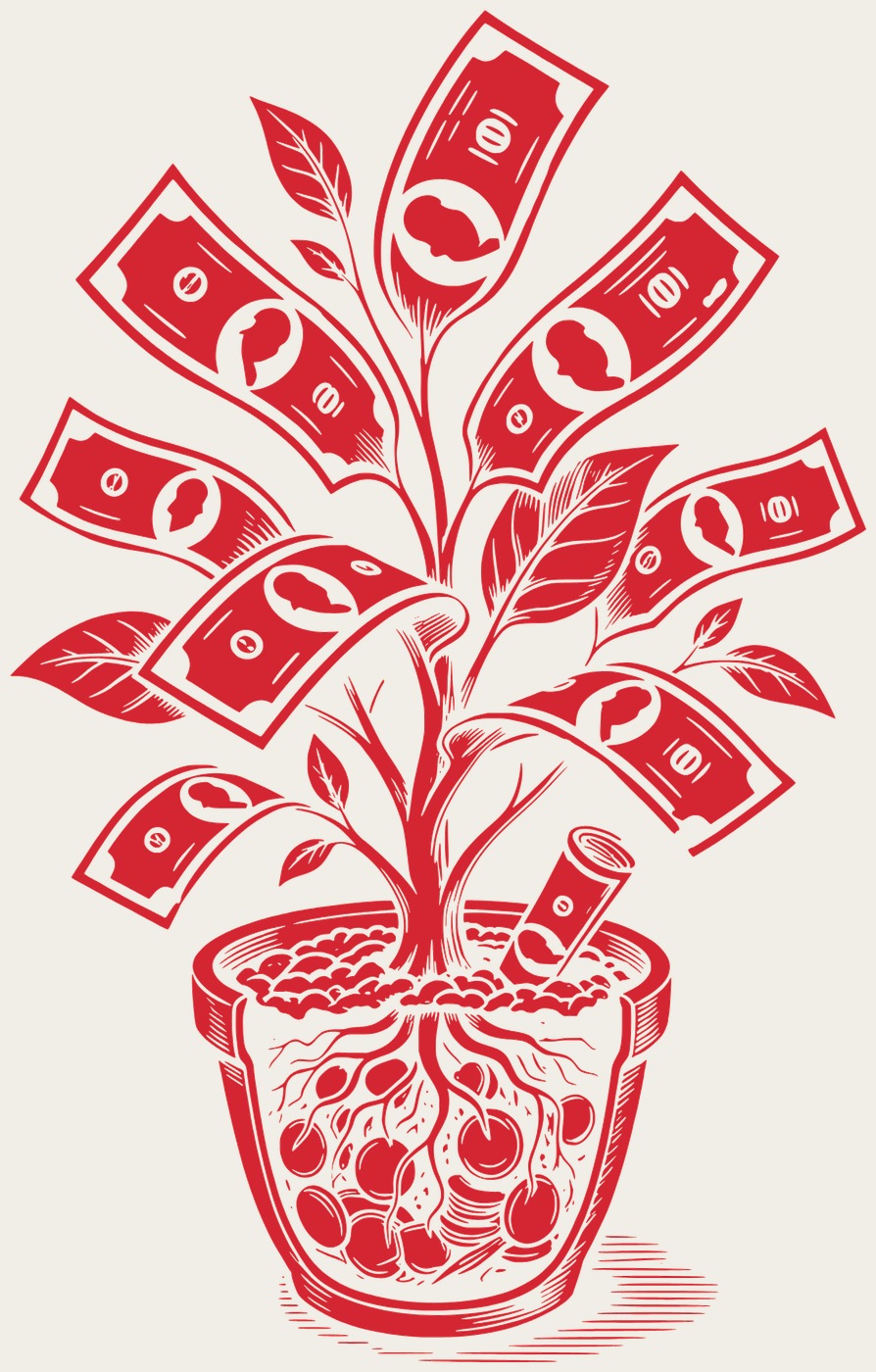
Illustration of a money tree growing from a pot with coins and roots, the symbol of Farmflation

You are in a toxic relationship with inflation

You didn't choose it, you didn't sign anything, you can't move away from it, and there's no paperwork that dissolves it. You live together twenty-four hours a day, from your first paycheck to your last. And like any relationship you can't leave, it has several faces.

The friendly face

You bought a property on credit. Year after year you watch it appreciate while the debt shrinks on its own. There, inflation works for you — and you love it, even if you'd never say so out loud.

The hostile face

The supermarket. The same cart, the same products, and a higher bill every month. There, inflation takes money out of your pocket, and you hate it with the same sincerity you loved it with in the paragraph above.

The deceptive face

Your raise comes through and you celebrate. But you weren't given anything: you got back part of what had been taken from you, and late. Celebrating it means celebrating getting back a little of what they took.

«From euphoria to anger and from anger to euphoria, month after month, for forty years of working life. That you never quite understand this bond isn't a side effect — it's the condition that makes it work.»

When prices rise, power always finds someone to blame

Diocletian · year 301

The Edict on Maximum Prices

The recipe, in one line: if prices rise, ban them from rising.

The Roman Empire had debased its currency again and again throughout the third century. The emperor's response wasn't to curb the money supply, but to set price caps on more than a thousand goods, wages, and freight — enforced with severe penalties, including death.

Irony: the government had debased the currency, then punished merchants because prices had gone up.

Richard Nixon · year 1971

Ninety days of freeze

The recipe, modern version: fight inflation by freezing prices.

In August 1971, Nixon froze wages and prices for ninety days. Inflation didn't disappear: it was simply ordered not to show up in the index. Once the controls were lifted, it came back stronger.

Illusion: mistaking the thermometer for the fever.

This book is about what to plant

Farmflation comes from two words: farming and inflation. Every asset you hold relates to inflation differently: some capture it, others sink under it. The book sorts it all into four parts.

1

The origin and history of inflation

Why money loses value, who decides that it does, and why that isn't about to change — from Diocletian to the Federal Reserve.

2

Assets not worth planting

Cash, fixed-term deposits, nominal bonds: why they silently lose the race against inflation, every single month.

3

Assets that hold their own

Gold, silver, inflation-linked bonds, rental real estate: what manages to break even with inflation, and at what cost.

4

Farmflation: assets that win

Stocks, accumulation and distribution portfolios, and Berkshire Hathaway, Bitcoin in its proper dose — what actually beats inflation.

Signal and noise

A stock's price goes up and down every day: that's noise. What matters is the underlying trend, the signal — and that signal only counts if it beats inflation.

Signal and noise chart A thick dotted line represents the noise of the daily price. A smooth black line represents the signal: the nominal business. A red line, falling further behind over time, represents that same business in real terms, discounted for inflation, with arrows showing how much inflation takes away over time. time →
Price, the daily noise.
The signal, the nominal business.
The real business, discounted for inflation.

«The price (reality) oscillates around the business's growth trend; inflation marks the floor that trend has to clear.»

Same trick, different centuries

Old Coppernose

Of all these episodes, one of my favorites is Henry VIII of England, who went down in history for the way he treated his wives — and maybe should have, too, for the way he treated his currency.

During his reign, the silver content of coins was slashed again and again. The surface layer of silver was so thin that it started wearing off right at the most prominent part of the royal portrait: the nose. And underneath, the copper showed through.

The English caught on and nicknamed the king Old Coppernose. The monarch's own face had become proof that the currency was debased.

An old trick — and, as you'll see through the rest of the book, very much alive today.

Chapter 1 — Currency.

The United States today, and an anecdote

The anecdote is so surreal it sounds made up. In early 2001, Alan Greenspan, chairman of the Federal Reserve, told the Senate that after several years of fiscal surplus, official projections contemplated the possibility that the federal debt held by the public could essentially disappear within the next decade — and he was already weighing the problems that would create.

The concern was genuine and technically legitimate, because the Treasury bond is a central piece of the world's financial infrastructure: the risk-free rate benchmark, the refuge for liquidity, the instrument through which monetary policy is carried out. What would happen if it stopped existing?

Compare that scene with today. The same country that in 2001 was debating what to do if it ran out of debt now owes more than $40 trillion — forty million millions. It didn't take a revolution or the end of capitalism: it was enough for governments to keep doing, for twenty-five years, what politicians have every incentive to do.

Chapter 3 — The deficit. Data as of September 2026.

Pablo Fuchsberger, author of Farmflation

Pablo Fuchsberger

Uruguayan, with a degree in Computer Engineering and an MBA, and thirty years of experience in the markets. He began his career at Fondos Santander, where he took part in managing four investment funds. In 2000 he co-founded a Spanish-language financial news portal with brokerage services, and later co-founded and managed three private investment funds.

He specialized in investments and models tied to volatility, focusing on time-series analysis using unconventional techniques such as artificial intelligence. His opinion columns on technology and financial markets appear in several publications.

Start farming before inflation harvests first

Paperback, 2026 edition. Shipped through Amazon.

USD 19.99 + shipping